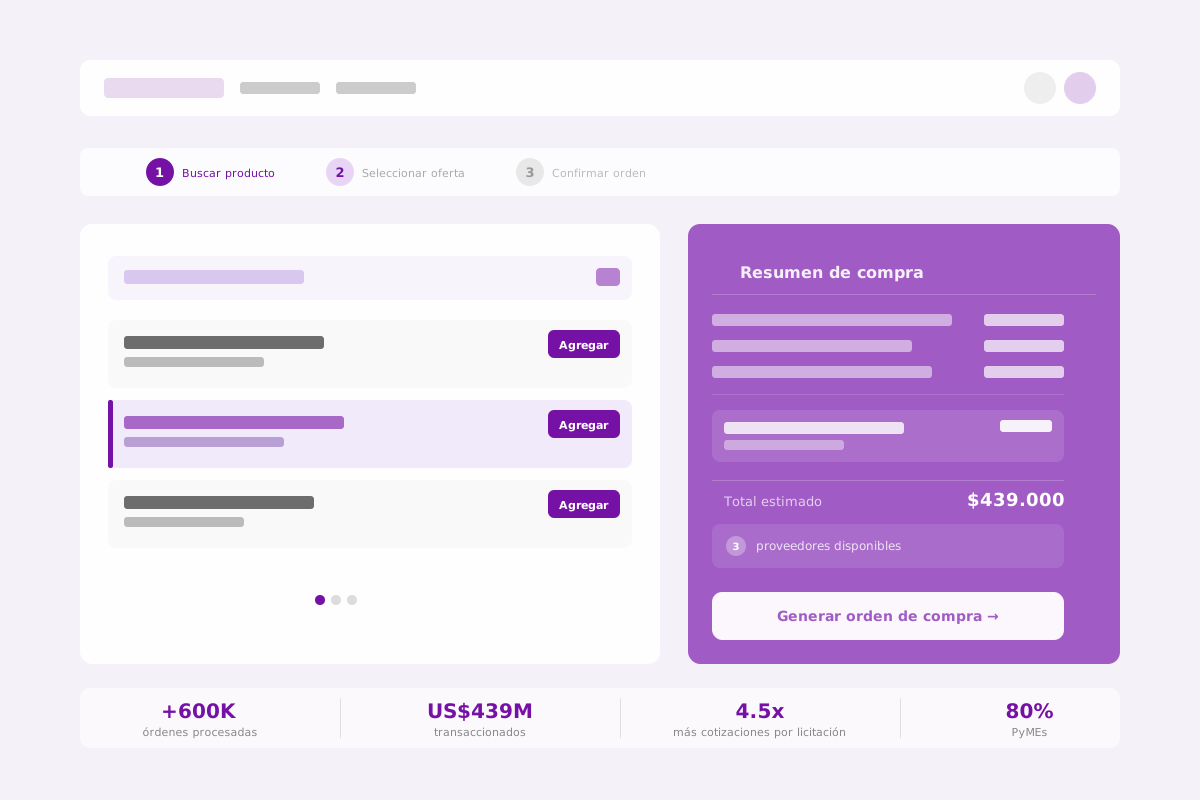
A new law, no product to run it
The new public procurement law established Compra Ágil: a special modality initially for acquisitions up to 30 UTM, later extended to 100 UTM. The promise was simple — more speed, less bureaucracy. The stakes were high: 80% of all State purchases fall within this range, and no digital tool existed to operate the new modality. Someone had to design it from scratch.
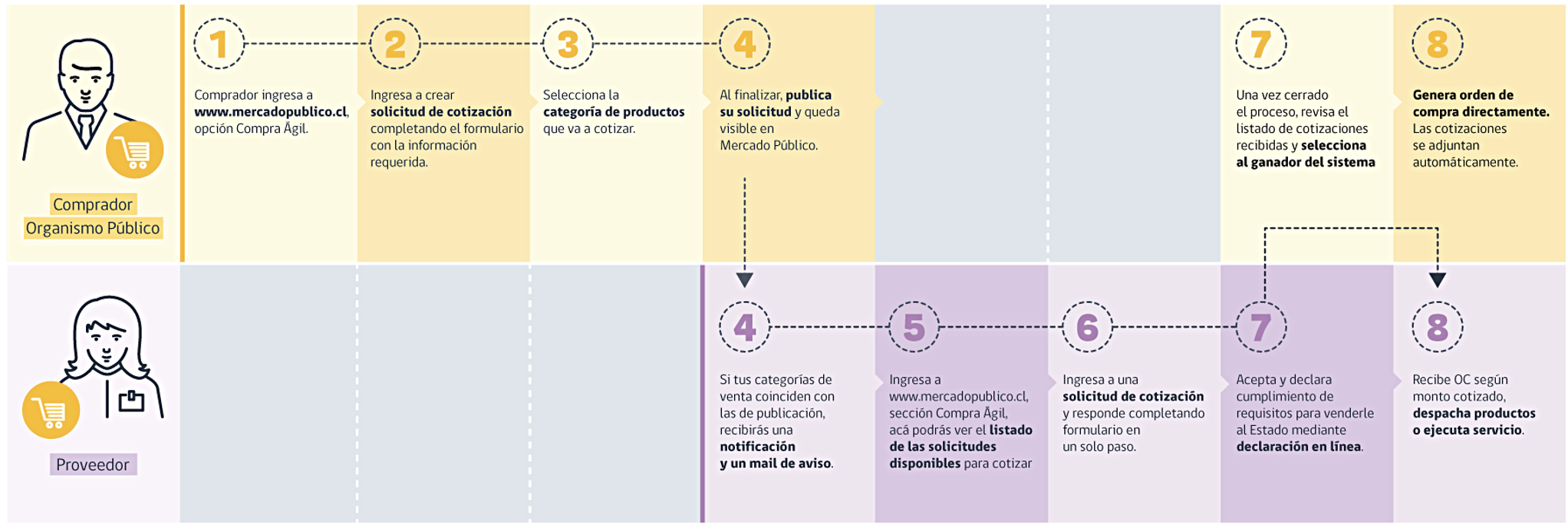
I led the design of that product: from strategic definition to interface components, including the flow architecture for both sides of the market — government agencies that buy and suppliers that quote.
The goal was not to digitize the existing process. It was to replace it.
Eliminate the technical requirements document. Remove intermediate administrative acts. Simplify the quotation process to a single step. If the flow is clear for both buyers and suppliers, cycle time drops and market participation grows.
A structured approach to an undefined problem
Designing a product from scratch — with no precedent and a hard launch deadline tied to a new law — required a clear methodology. We followed a Double Diamond process: understand deeply before defining, define before prototyping, and build in a feedback loop from day one.

The product serves two very different users simultaneously. Every design decision had to work for both sides of the market without creating asymmetry or confusion.
Listening to both sides before designing anything
We ran more than 30 in-depth interviews with public agencies and suppliers — hospitals, regional institutions, municipalities, and small businesses — using qualitative exploratory methods to understand their real experience with public procurement before touching any interface.
”We have to run a full tender to buy printer paper. The process is the same as for an infrastructure project.”
Procurement unit, public agency
”As a small supplier I have no way of knowing if there are purchases in my sector. I find out through contacts, not through the platform.”
Service provider, Metropolitan region
”An urgent purchase can take weeks. By the time the order arrives, I’ve already solved the problem another way.”
Head of supply, municipality
Mapping what didn’t exist yet
With the research findings clear, the work shifted to defining the product’s architecture before any screens. Each step had to be validated before moving forward.
Regulatory scope definition
Reading and synthesis of the new law. Interviews with the legal team and procurement units to understand exactly what the law mandates and what remained as a design decision.
Flow mapping for two profiles
The product has two sides: buyers who publish and suppliers who quote. I mapped both journeys separately before looking for convergence and divergence points.
Status system architecture
Before any screen, I designed the complete taxonomy of order statuses. Without that structure, the system has no criterion — only appearance.
Prototyping, validation and handoff
Iterative prototypes of the search interface, publishing form and order detail. Validation with real buyers from public agencies, then documentation for development.
A status system before any screen
Each status has its own meaning, semantic color and set of allowed actions. They are readable for both the buyer and the supplier equally — not just labels, but behavioral contracts that define what each user can do at every moment.
The buyer selected a quote and issued the order. The supplier must accept within the deadline. Highest urgency status for the supplier.
The purchase is active. Any enabled supplier can quote within the published deadline. Main opportunity status.
There were not enough quotes in the first call. The deadline is extended, a second opportunity for suppliers.
No valid quotes were received. Terminal status, the buyer must start a new process.
The agency cancelled the purchase before completing the process. Can occur at any active stage.
The deadline ended. The buyer is evaluating proposals. Waiting status for the supplier.
Key design decision: statuses define what the user can do at each moment. The color, text and available actions change according to the status. The system has criterion, not just appearance.
The product went live the same day as the law
In less than two years of operation.
Total volume processed through Compra Ágil since launch.
Of total amounts adjudicated went to micro, small and medium businesses.
High competition rate — a transparent, open market in practice.
Eliminated the technical requirements document and all intermediate administrative acts.
The product launched the same day the new regulation came into effect.